Seasonal cycles and agricultural life
The PeasantsSeasonal cycles and agricultural life are not a backdrop to life in Lipce but its organizing measure: they set the pace of work and celebration, expose households to scarcity, and make weather a force that can alter the village itself. The movement from harvest abundance to winter confinement, from thaw to drought, and finally to rain gives the changing year material consequences as well as symbolic weight. Human plans unfold within that cycle, never wholly apart from the demands and risks of land, water, crops, and weather.
The agricultural calendar and communal time
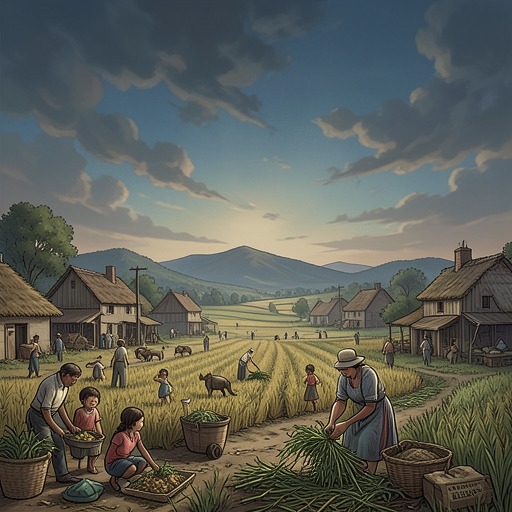
The cycle is first made visible through work. During the cabbage harvest, the village grows quiet because nearly everyone is out in the fields. Muddy roads and empty farmyards give way to the slow passage of carts loaded with cabbages; geese follow after any leaves that fall. The pond swells beyond its banks, flooding the lower road beside Maciej Boryna’s property and sending foam against fences and cottage walls. Inside the village, harvested cabbages fill threshing floors, hallways, and rooms, rising in places nearly to the eaves, while large barrels stand soaking in the rain outside. The scene connects the season’s abundance to storage and household labor: crops must be gathered, brought home, and prepared for what follows.
After the summer’s fieldwork, autumn provides a recognized interval for communal enjoyment. At the wedding of Jagna and Maciej Boryna, the celebration is framed as a proper reward for labor: hayricks are full, wheat fills the barn, and the threshing is still to come. The villagers drink, dance, and share their troubles, while talk moves from private grief to old grievances, taxes, and matters concerning the community. The wedding’s long dancing carries the gathering through the night until dawn begins to pale the sky. Its exuberance is not detached from agricultural life; it is presented as the rest and fellowship made possible by work completed in the fields.
Winter as weather, confinement, and shared endurance
The turn to winter changes both the landscape and the villagers’ movements. As the season approaches, it is imagined as a force struggling against autumn before it can seize the world with ice. Soon after St Barbara’s Day, the first winds sweep through Lipce, tearing at fields, gardens, roofs, and fences. A further gale strips away the remaining snow, while frost hardens the roads and ground. This weather is more than seasonal scenery: it affects buildings, travel, and the basic conditions of daily work.
During the winds, older villagers stay inside smoky cottages, where enforced idleness makes tempers fray. Women occasionally go out under the pretext of carrying a distaff to a neighbor, chiefly to talk and complain; men continue threshing behind closed barn doors, and a farmhand ventures to the inn only when the gale briefly slackens. The streams and marshes freeze, and the pond acquires a pale-blue cover of ice. Water must be hacked out near the bridge, where deeper water still runs. Winter thus narrows ordinary movement but does not stop the work required to sustain farm life.
Snow transforms the village again. For two days and two nights, it falls until cottages are nearly buried, roads merge with fields, and the pond disappears beneath the drifts. The first response is practical: people dig paths between cottages, clear doorways, and open byres. But the snowfall also brings children and dogs into the newly altered landscape; sledges, snowmen, and snowball fights make the yards lively, and Rocho suspends lessons because the children cannot be kept at their primers. The same weather that blocks travel and covers familiar paths also creates a temporary communal world of play.
Thaw, conflict, and the vulnerability of crops
Seasonal change does not guarantee an easy renewal. In mid-March, as the ground thaws and sap begins to rise, word spreads that The Squire is felling the peasants’ forest. The timing makes the news difficult for villagers to accept, but the spring conditions give the dispute immediate stakes: the land is changing, and the forest is being worked at the point when new growth is beginning. The episode places property and access to resources within the agricultural calendar, rather than outside it.
By the end of May, the season turns threatening in another way. Heatwaves arrive so frequently that the weather resembles July. Streams dry up; vegetables yellow and wilt, fallow grass is scorched, and potato plants that began well barely cover the ground. Winter crops fare better, with heavy heads and tall growth, but the contrast offers no general security: one crop’s promise coexists with damage to others. The heat also alters domestic life, as the nights grow so oppressive that people sleep in orchards because their houses are unbearable. Crop risk, bodily discomfort, and village unrest gather in the same preharvest period, when hardship is already acute.
Nature’s independent force and the cycle’s meaning
The narrative repeatedly gives natural forces their own momentum. The pond strains against its banks during the cabbage harvest; winter winds tear at the built environment; snow erases roads and landmarks; drought dries streams and damages crops. These conditions are not merely reflections of human feeling. They impose practical limits on travel, water, shelter, and food, and their effects fall on the households and workers who depend on the land. The changing year is therefore both a familiar rhythm and a material uncertainty.
After the news of Maciej Boryna’s death, fine, warm rain begins to fall. It fills the fields and orchards with the sound of drops and gives water to thirsty crops, drooping leaves, trees, dried streambeds, and parched earth. The rain’s arrival does not undo death, but it restores moisture to a landscape depleted by heat. Set beside winter’s covering snow and the damage of summer drought, it gives the seasonal pattern a hard-earned sense of renewal: the natural world continues to change, while human lives and losses remain bound to its cycles.